Amsterdam combines the unrivaled beauty of the 17th-century Golden Age city center with plenty of museums and art of the highest order, not to mention a remarkably laid-back atmosphere. It all comes together to make this one of the world's most appealing and offbeat metropolises in the world. Built on a latticework of concentric canals like an aquatic rainbow, Amsterdam is known as the City of Canals—but it's no Venice, content to live on moonlight serenades and former glory. Quite the contrary: on nearly every street here you'll find old and new side by side—quiet corners where time seems to be holding its breath next to streets like neon-lit Kalverstraat, and Red Light ladies strutting by the city's oldest church. Indeed, Amsterdam has as many lovely facets as a 40-carat diamond polished by one of the city's gem cutters. It's certainly a metropolis, but a rather small and very accessible one. Locals tend to refer to it as a big village, albeit one that happens to pack the cultural wallop of a major world destination. There are scores of concerts every day, numerous museums, summertime festivals, and, of course, a legendary year-round party scene. It's pretty much impossible to resist Amsterdam's charms. With 7,000 registered monuments, most of which began as the residences and warehouses of humble merchants, set on 160 man-made canals, and traversed by 1,500 or so bridges, Amsterdam has the largest historical inner city in Europe. Its famous circle of waterways, the grachtengordel, was a 17th-century urban expansion plan for the rich and is a lasting testament to the city’s Golden Age. This town is endearing because of its kinder, gentler nature—but a reputation for championing sex, drugs, and rock ’n’ roll does not alone account for Amsterdam's being one of the most popular destinations in Europe: consider that within a single square mile the city harbors some of the greatest achievements in Western art, from Rembrandt to Van Gogh. Not to mention that this is one of Europe's great walking cities, with so many of its treasures in the untouted details: tiny alleyways barely visible on the map, hidden garden courtyards, shop windows, floating houseboats, hidden hofjes(courtyards with almshouses), sudden vistas of church spires, and gabled roofs that look like so many unframed paintings. And don’t forget that the joy lies in details: elaborate gables and witty gable stones denoting the trade of a previous owner. Keep in mind that those XXX symbols you see all over town are not a mark of the city's triple-X reputation. They're part of Amsterdam's official coat of arms—three St. Andrew's crosses, believed to represent the three dangers that have traditionally plagued the city: flood, fire, and pestilence. The coat's motto ("Valiant, determined, compassionate") was introduced in 1947 by Queen Wilhelmina in remembrance of the 1941 February Strike in Amsterdam—the first time in Europe that non-Jewish people protested against the persecution of Jews by the Nazi regime.
Allow about 10 min each way from the terminal to the city center. Average time in port: 9 hours. 27 places to explore.
Ships calling here
25 ships
Upcoming sailings
936 sailings
Average time in port
About 9 hours
Lowest fare
From USD 824
After disembarking
Cruise ships dock at Amsterdam cruise terminals. Allow about 10 min each way from the terminal to the city center.
2 cruise terminals
The assigned dock is one of Passenger Terminal Amsterdam (PTA), IJmuiden Felison Cruise Terminal (Outer Port) and varies by sailing.
OVpay Contactless Payment on Amsterdam Public Transport
Amsterdam trams, buses, metro, and NS trains support contactless payment (OVpay). Tap an international credit card or mobile payment device to check in and check out.
Advance Reservations Required for Major National Museums and Anne Frank House
The Van Gogh Museum and Anne Frank House do not operate onsite ticket offices, so you must reserve an entry time in advance through their official websites before your port call.
About 9 hours in port: where can you go?
Time available at the destination after subtracting return travel.
Calculated from the average time in port. Return deadlines vary by sailing; check the daily programme on board.
Between the terminal, city and airport
Travel between the terminal, city center, railway station and airport.
TramAbout 5 minEUR 3.40
Passenger Terminal Amsterdam → Amsterdam Centraal
At the ‘Muziekgebouw Bimhuis’ stop directly in front of the terminal, take tram 26 toward Amsterdam Central Station and get off one stop later. If you have little luggage, it is about a 12-minute walk.
TramAbout 5 minEUR 3.40
Amsterdam Centraal → Dam Square
At the tram stop in front of the central station, take tram 4, 14, or 24 and get off at ‘Dam’. Walking along Damrak also takes about 10 minutes.
TrainAbout 20 minEUR 4.20~EUR 4.50
Amsterdam Centraal → Zaandijk Zaanse Schans
At Amsterdam Central Station, take an NS Sprinter local train toward Zaandam / Alkmaar, get off at ‘Zaandijk Zaanse Schans’, and walk about 12 minutes to reach the windmill village.
TrainAbout 15 minEUR 4.90~EUR 5.90
Amsterdam Centraal → Schiphol Airport
At platform 14 or 15 at the central station, take a direct Intercity train to Schiphol Airport. It reaches the underground airport station in 14 minutes with no transfer.
Amsterdam places to explore
Explore 22 checked places. Select a pin to see its card, or choose View on map from a card.
Sights
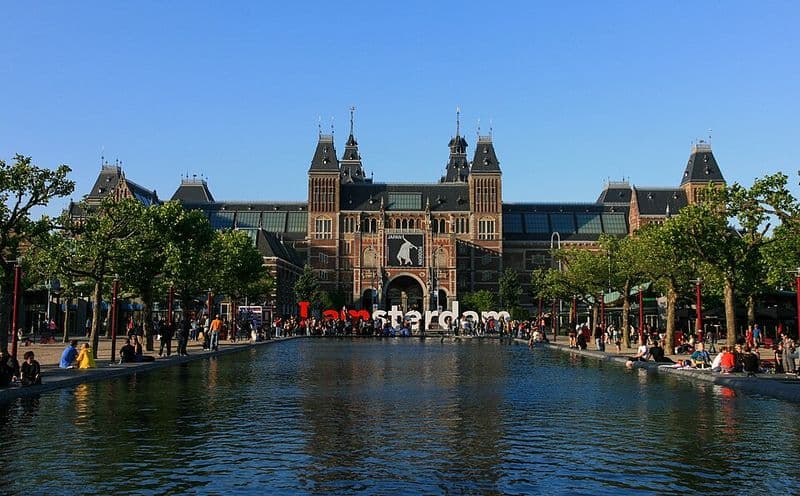
Rijksmuseum
The Netherlands' largest and leading national art museum, home to Rembrandt's The Night Watch and Johannes Vermeer's The Milkmaid.
Visit
about 2 hr
Admission
EUR 22.50~EUR 25
Hours
Daily 09:00–17:00
You must book a timed online ticket in advance to enter without waiting.
A world-famous museum focused on Vincent van Gogh's artistic life, displaying around 200 of his oil paintings and around 500 drawings in chronological order.
Visit
about 1 hr 40 min
Admission
EUR 22~EUR 24
There is no ticket sales on site, so online timed reservations several weeks in advance are essential.
A grand classical stone building constructed as Amsterdam's city hall in the 17th-century Dutch Golden Age, still used for official royal events and receptions.
Visit
about 1 hr
Admission
EUR 12.50~EUR 15
Hours
Daily 10:00–17:00
General viewing may be restricted without prior notice during official royal events or state visits.
A distinctive green, ship-shaped building designed by Renzo Piano, with a rooftop terrace offering panoramic views of Amsterdam Harbor and the city center.
Visit
about 1 hr
Admission
EUR 17.50~EUR 19.50
Hours
Daily 09:30–17:30
The rooftop terrace plaza can be accessed free of charge by walking up the stairs without a museum ticket.
With enough time in port, you can explore beyond the city. One-way times are approximate.
Zaanse Schans
About 30 min each wayTime at destination About 8 hr
SightsZaans Museum & Verkade Pavilion
The museum presents the industrial history and traditional life of the Zaan region, with early 20th-century Verkade chocolate and biscuit factory equipment vividly recreated.
Staff in traditional dress demonstrate the traditional making of Gouda and Edam cheeses; visitors can sample dozens of Dutch cheeses for free and buy them.
Vacuum-packed wheel cheese can be stored at room temperature, making it suitable as a souvenir during a cruise port call.
Food and cafésRestaurant De Hoop op d'Swarte Walvis
A historic traditional restaurant on the banks of the Zaan, where you can enjoy Dutch fish dishes and meat courses while looking out at the river and windmills.
Waterfront terrace seats are popular on mild-weather days.
An open-air heritage village preserving traditional 17th- and 18th-century windmills along the Zaan River, where visitors can look inside working historic mills once used to grind oil, pigments, and wood.
Walking around the village outdoors is free, but a small fee is charged to enter individual operating windmills.
Amsterdam combines the unrivaled beauty of the 17th-century Golden Age city center with plenty of museums and art of the highest order, not to mention a remarkably laid-back atmosphere. It all comes together to make this one of the world's most appealing and offbeat metropolises in the world. Built on a latticework of concentric canals like an aquatic rainbow, Amsterdam is known as the City of Canals—but it's no Venice, content to live on moonlight serenades and former glory. Quite the contrary: on nearly every street here you'll find old and new side by side—quiet corners where time seems to be holding its breath next to streets like neon-lit Kalverstraat, and Red Light ladies strutting by the city's oldest church. Indeed, Amsterdam has as many lovely facets as a 40-carat diamond polished by one of the city's gem cutters. It's certainly a metropolis, but a rather small and very accessible one. Locals tend to refer to it as a big village, albeit one that happens to pack the cultural wallop of a major world destination. There are scores of concerts every day, numerous museums, summertime festivals, and, of course, a legendary year-round party scene. It's pretty much impossible to resist Amsterdam's charms. With 7,000 registered monuments, most of which began as the residences and warehouses of humble merchants, set on 160 man-made canals, and traversed by 1,500 or so bridges, Amsterdam has the largest historical inner city in Europe. Its famous circle of waterways, the grachtengordel, was a 17th-century urban expansion plan for the rich and is a lasting testament to the city’s Golden Age. This town is endearing because of its kinder, gentler nature—but a reputation for championing sex, drugs, and rock ’n’ roll does not alone account for Amsterdam's being one of the most popular destinations in Europe: consider that within a single square mile the city harbors some of the greatest achievements in Western art, from Rembrandt to Van Gogh. Not to mention that this is one of Europe's great walking cities, with so many of its treasures in the untouted details: tiny alleyways barely visible on the map, hidden garden courtyards, shop windows, floating houseboats, hidden hofjes(courtyards with almshouses), sudden vistas of church spires, and gabled roofs that look like so many unframed paintings. And don’t forget that the joy lies in details: elaborate gables and witty gable stones denoting the trade of a previous owner. Keep in mind that those XXX symbols you see all over town are not a mark of the city's triple-X reputation. They're part of Amsterdam's official coat of arms—three St. Andrew's crosses, believed to represent the three dangers that have traditionally plagued the city: flood, fire, and pestilence. The coat's motto ("Valiant, determined, compassionate") was introduced in 1947 by Queen Wilhelmina in remembrance of the 1941 February Strike in Amsterdam—the first time in Europe that non-Jewish people protested against the persecution of Jews by the Nazi regime.
Cruise lines calling here: 9 places
Atlas Ocean VoyagesCelebrity CruisesEmerald CruisesHolland America LineMSC CruisesNorwegian Cruise LinePrincess CruisesRegent Seven Seas CruisesVirgin Voyages